
JUNE 2026
ISSUE 07

AIG QUARTERLY
Welcome to the seventh edition of Art Intelligence Global’s quarterly newsletter. Informed by our extensive global reach, our reporting covers major developments and in-depth analysis of the international art market. If you would like to discuss further, please contact us at info@artintelligenceglobal.com.

_________
Driven by strong tailwinds, the category appears primed for further growth
The Rise of Modern & Contemporary South Asian Art
The results of Christie's recent auction of South Asian art make the case in stark numbers. Across the single-owner sale, all 93 lots – led by a £3.8m ($5m) canvas by Ganesh Pyne – sold above their high estimates to achieve £18.9m ($24.9m), a record for Christie’s London in the field. The sale is the latest sign of a category in strong and sustained ascendance since the Covid pandemic.
Much of this explosive growth has been anchored in deep demand for stellar examples by artists who worked at the forefront of Indian modernism, particularly figures associated with the Bombay Progressive Artists' Group (PAG). Established after the Partition in 1947, the PAG emerged out of frustration with the doctrinal teachings of colonial art schools. Founding members such as F.N. Souza, S.H. Raza, and M.F. Husain created a new language for modern art in India, forging a variety of forms that, whilst informed by Western technical and stylistic developments, heralded the importance of the nation’s own artistic past. These paintings varied between styles of figuration – often Cubist in feeling with strong linearity – and non-representational forms abstracted from architectural geometries, linguistic symbols, or meditative Tantric imagery: each idiom reflected complex notions of identity and history. In the last three years, auction records across the PAG and its orbit have been regularly broken: M.F. Husain has achieved $13.8m; F.N. Souza $7.6m; Tyeb Mehta $7.3m; S.H. Raza $5.6m; and J. Swaminathan $4.7m. Indeed, off-market private sales have seen even higher prices for some of these major figures.
South Asia has long been home to a venerable visual culture, one reflective of the region’s cultural, ethnic, spiritual, and linguistic diversity. During the nineteenth and twentieth-centuries, colonial intervention disrupted the artistry of the region, spurring a decisive return to indigenous subjects, styles, and techniques in the decades following the seismic rupture of Partition in 1947, which ended British rule and gave rise to the independent nations of India and Pakistan. A group of avant-garde painters soon laid the foundations for subsequent generations of artists to interrogate their own layered histories. For decades, Modern and Contemporary South Asian art has struggled to permeate beyond regional boundaries of the international art market, eclipsed by other more established categories. That now appears to be shifting, bolstered by the region’s rising economic might and a new generation of collectors determined to champion the category on the global stage.
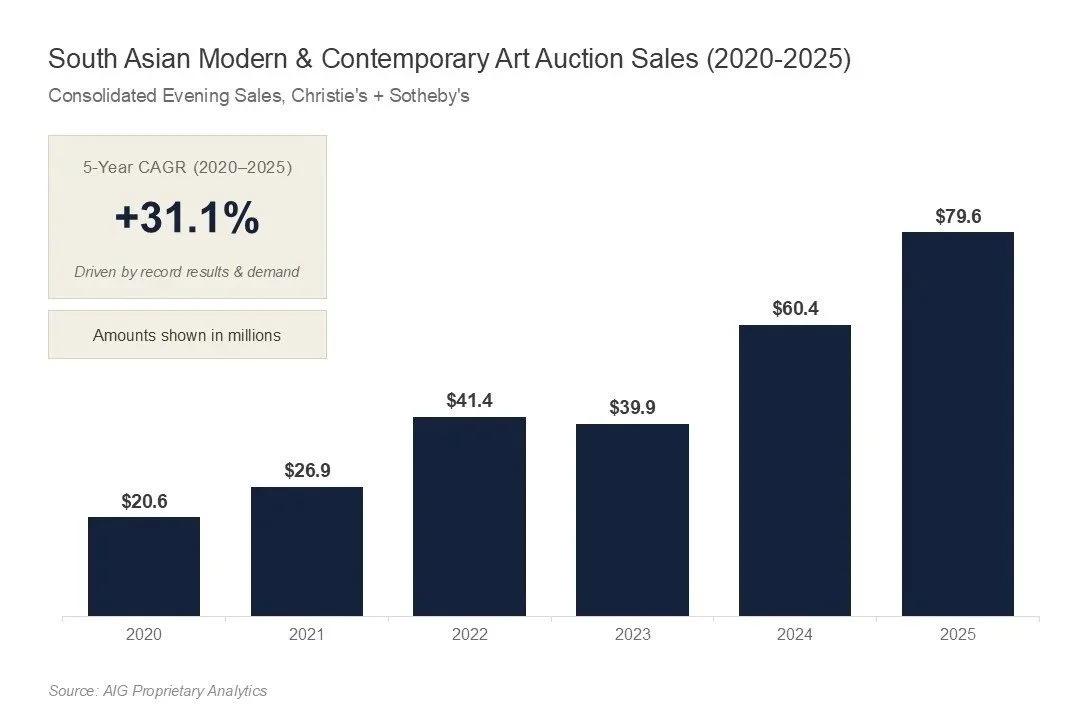
While these modern masters dominate at the very top end of the market, the rich variety of subjects, perspectives, techniques, and mediums found throughout the category is central to its depth and complexity. Curator Adeline Ooi, formerly Director Asia for Art Basel, sees such ‘elasticity’ as characteristic of the region’s artistic production. In addition to the ‘vast territories and complex histories’ that have resulted in ‘differing realities for artists from one generation to the next,’ Ooi notes ‘the use of materials, adopting age-old techniques but applying them to contemporary contexts – the interstices of this collision are very exciting.’ Indeed, the prevalence of ceramics, collage, printmaking, and textile works is striking, particularly among the region’s artists working today.
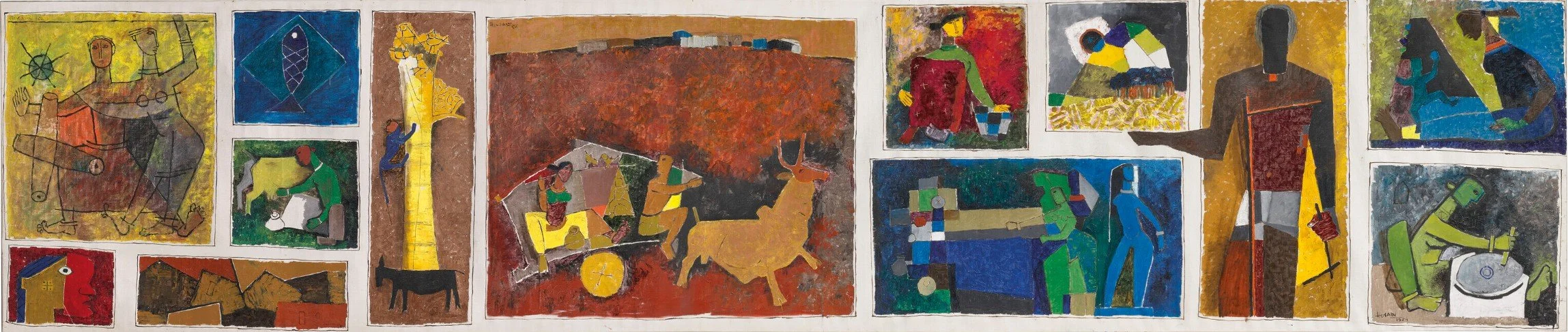
M.F. Husain, Untitled (Gram Yatra) (1954), oil on canvas, 35.5 × 166.4 in. 90.2 × 422.6 cm. Sold Christie’s New York, 19 March 2025, $13,750,000
The macroeconomic backdrop is central to the story, with the strength of the Indian economy a decisive driver in the market’s rise. Now the world’s fifth-largest economy, the country has delivered average annual real GDP growth of 7.4% between 2022 and 2025 – comfortably outpacing that of China (4.6%) and the US (2.5%) in the same period (IMF Statistics). Within this landscape, the ultra-high-net-worth story is particularly notable. Between 2021 and 2026, India's population of individuals with assets exceeding $30 million grew by 63%, rising from just over 12,000 to nearly 20,000, within which the billionaire count grew 58% to 207, third only to the US and China – a reflection of fast-paced wealth creation across technology, industrials, and capital markets. According to Knight Frank, a further 27% increase in UHNWIs is forecast by 2031, which would take the total above 25,000.
Ishrat Kanga, the recently departed Co-Worldwide Head of Modern and Contemporary South Asian art at Sotheby’s, has seen this wealth creation translate into a new generation of collectors, for whom ‘art is increasingly viewed as both a cultural asset and a store of wealth.’ Engaged economic muscle bodes well for future growth, too: ‘A broader, wealthier, and more globally distributed group of buyers is creating sustained demand rather than short-term spikes,’ while she also notes that, at the mid-tier level, a new generation of ‘research driven millennial and Gen Z collectors are actively shaping the next phase of the market.’ In September 2025, the Indian government cut the Goods and Services Tax levied on artworks from 12% to 5%, a further boost to the industry.
A broader,
wealthier, and more globally distributed group of buyers is creating sustained demand rather than short-term spikes.
— Ishrat Kanga

The recent growth has coincided with a surge of institutional activity centered on South Asian art, particularly in the UK, long a hub for the region’s collectors. Driving these developments, Ooi notes ‘an active reframing of art history to better reflect the diversity of artists, the history of migration of peoples and asylum seekers who have called UK home.’ The Barbican’s The Imaginary Institution of India (2024) marked the first major South Asian exhibition at a London public institution since 2016. Last year, the Serpentine presented a solo exhibition of the modernist Indian painter Arpita Singh, followed by the Royal Academy’s display of sculptor Mrinalini Mukherjee and her contemporaries (since travelled to the Hepworth Wakefield).
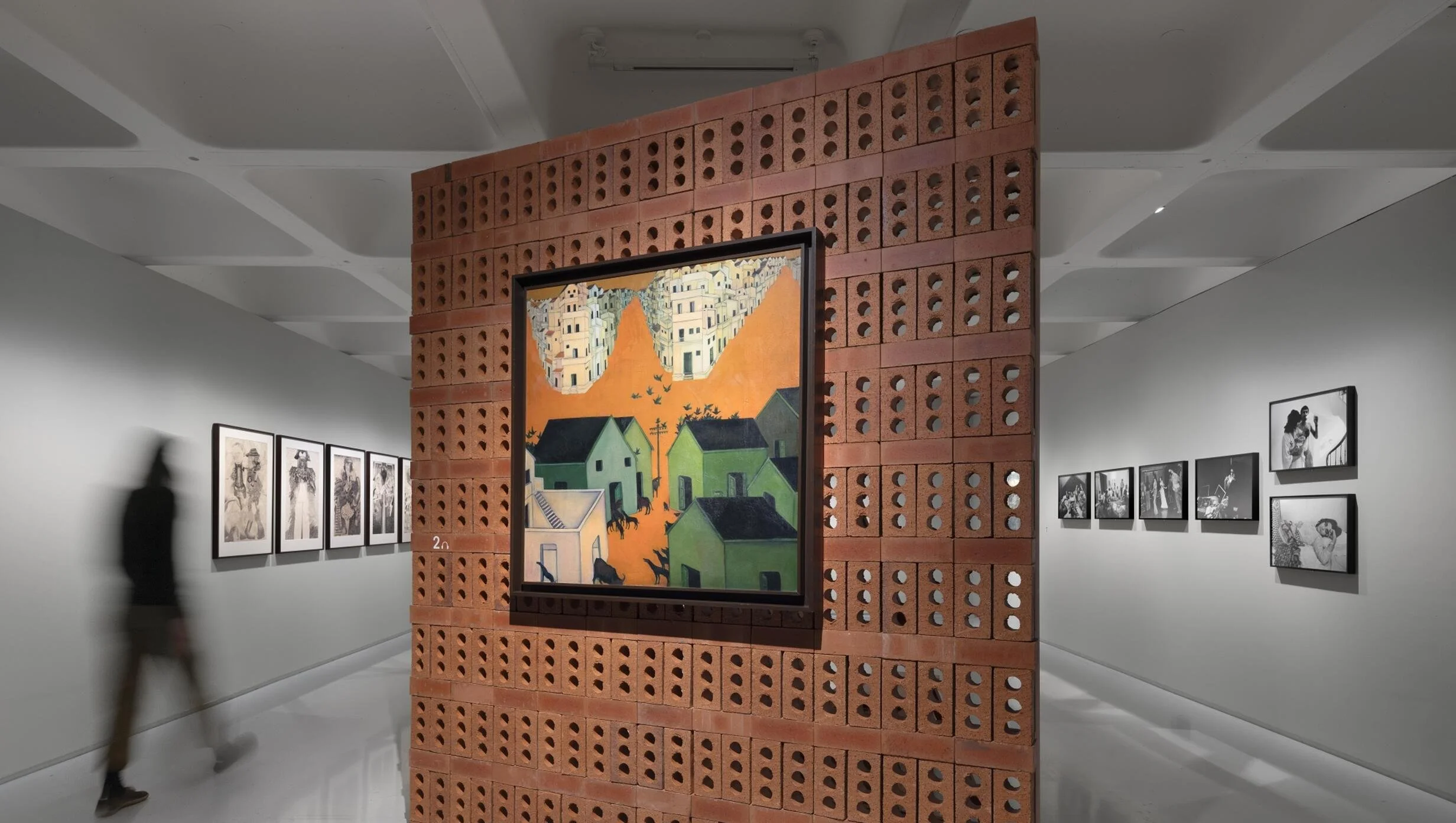
Installation view, The Imaginary Institution of India: Art 1975-1998, Barbican Center, London, October 2024 - January 2025
In 2024, the return of the Indian pavilion to the Venice Biennale – for the first time in seven years – also signaled renewed engagement with contemporary Indian practice on the global stage. Domestically, the Kiran Nadar Museum of Art has established itself as a beacon of patronage, alongside the Nita Mukesh Ambani Cultural Centre and the Foundation for Indian Contemporary Art, among others. Further afield, the Ishara Foundation and the Jameel Art Center – both in Dubai – and the Sharjah Art Foundation have elevated the visibility of South Asian art across the wider region.
Local market infrastructure has evolved, too, meeting new levels of demand supplied by an increasingly wealthy audience with greater disposable income. The number of galleries has grown, and more regional artists are gaining international representation. In 2025, No. 9 Cork Street hosted two Indian galleries – Vadhera Art Gallery and Project 88 – bringing their programs directly into one of London's most prominent gallery destinations. Long-established galleries like Jhaveri Contemporary or Chemould Prescott Road have also emerged as key supporters, whose connoisseurship and logistical support have been essential in bringing major exhibitions to life. Beyond galleries, a new generation of collectors is attending a growing calendar of events, such as the India Art Fair, Art Mumbai, India Art Festival, Chennai Photo Biennale, Jaipur Art Week, Lahore Biennale, Dhaka Art Summit, or Colomboscope in Sri Lanka.
Suddenly there is an influx of audience — a generation has grown up and are now frequenting galleries.
— Adeline Ooi

Driven by record results, an expanding gallery scene, and institutional exposure, the South Asian market is undoubtedly riding high. At auction, Kanga has seen how ‘strong prices have encouraged owners to release fresh material, and the consistent appearance of significant pieces has reinforced confidence.’ Between 2006-08, the category saw a dramatic surge – and rapid fall – in prices, fueled by speculation. This time, however, the category appears to be better positioned for robust structural, rather than cyclical, expansion. Not only is the pool of buyers deep and more diverse than before the 2008 Global Financial Crisis, ‘collectors today are far more cautious and informed. They are prioritizing works they genuinely want to live with and enjoy, treating any financial return as a secondary benefit. This shift in mindset has created a healthier, more sustainable market.’
The category’s visibility in cultural, institutional, and scholarly circles is also primed for further expansion. Migration from the region over successive generations has resulted in diaspora patronage around the world and a determination to foster exchange on a global scale. Ooi points out that, as patronage has become more sophisticated, some established figures have become ‘less interested in collecting but are putting funds towards supporting projects in and beyond local territories.’ It remains the case that the principal collecting base for South Asian art has local ties – relatively few western collectors have yet engaged meaningfully with the market. Nonetheless, with powerful demographic and economic tailwinds, and a maturing museum and gallery ecosystem to match, South Asian art is poised to make further inroads into the international art world’s upper echelons.
Reflections: Art Basel & London Sales
There was a palpable sense of activity in the air at this year’s edition of Art Basel, continuing the optimism that followed New York’s bulletproof marquee sales, where no less than $2.5bn of art sold across the three major auction houses. For the most past, galleries turned out in force with a strong selection of blue-chip secondary work, befitting the increasingly trade-orientated nature of Art Basel’s flagship fair. Risk-takers looking to capitalize on this period of market momentum were to be rewarded, with numerous seven and eight-figure sales reportedly executed during the opening days. That said, energy was concentrated around the center of the Messeplatz, where the largest galleries hosted sprawling booths; activity struggled to reach the further corners and second floor of the hall, where some primary-focused galleries found sales harder to come by.
The strong selection on display attested to galleries’ confidence, but also to a recognition that consignors should capitalize on current favourable market conditions – bolstered by the recent announcement of a fragile ceasefire in the Middle East. With oil prices still elevated, inflation fears persisting, and uncertainty lingering over the seemingly unabating AI trade boom, an overheated global economy could be expected to cool in the coming months. That said, there is a growing consensus among dealers and collectors alike that the idiosyncratic issues buffeting the art market over the past 24-36 months, namely those of primary oversupply and a gap in buyer and seller expectations, have largely receded, at least for the core, blue-chip segment of the market. Further, amidst a seemingly endless barrage of geopolitical headlines, alerts, and tweets, participants in the art market have seemed to adopt a new posture: buyers are finding refuge in collecting, looking beyond acute price sensitivity to have the chance to acquire scarce objects of historical value.
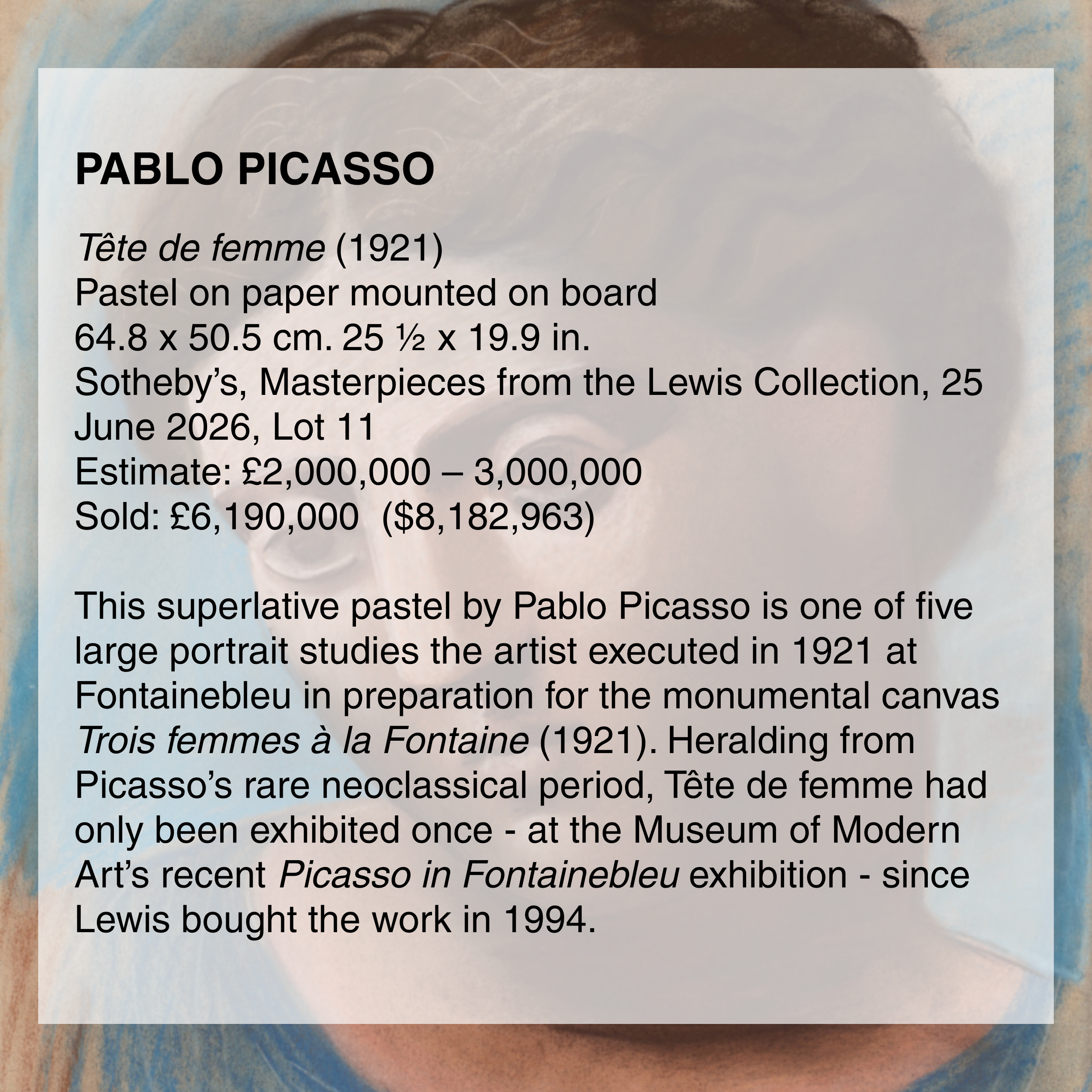
On the back of a strong Basel week, the June season in London aimed to capitalize further on the quietly optimistic tone set thus far in 2026. Sotheby's brought to market a second, more extensive trove of works from the collection of British financier Joe Lewis. The material catered well to a discerning market seeking rare blue-chip examples, fresh-to-market with strong provenance. Sotheby’s extensive marketing and regal installation of the collection in their New Bond Street galleries effectively emphasized the Lewis family’s focus on portraiture from the late 19th and 20th centuries: each work was elevated by the context of other masterpieces.
Attesting to the high expectations, The Lewis collection realized £296m ($392.6m) with buyer’s premium, significantly exceeding its £190.2m ($254.6m) presale estimate. Of the 25 lots offered, 12 surpassed their high estimates and only one failed to sell; a higher number of bidding wars throughout was perhaps an indication of the consignor’s refusal to take presale irrevocable bids in favour of an enhanced hammer strategy. René Magritte’s La Belle promenade (1965) – an exquisite and varied composition featuring a silhouette of the iconic ‘bowler-hatted man’ – ignited a flurry of activity to achieve £16m ($21.2m) with buyer’s premium, against an estimate of £3-4m, a new record for a work on paper by the artist. Deep bidding was also seen for choice examples by Gustave Caillebotte, Pablo Picasso, Edgar Degas, Henri Matisse, Max Beckmann, and Gustav Klimt. That said, two of the sale’s marquee lots – a pair of nudes by Lucian Freud and Modigliani – sold around their low estimates, indicating the air remains thin at the very top of the market and buyer’s remain price sensitive. Notably, activity from collectors in Asia was marked, with Sotheby’s reporting that collectors from the region bought or underbid half of the works in the sale.
The energy generated by the Lewis collection failed to fully materialize in the following various-owner evening sale. With an 85% sell-through rate and few instances of spirited bidding, the chasm between an exceptional, fresh-to-market collection and the rest was displayed well. The bulk of the value again resided with codified art historical titans: a Monet Nymphéas (returning to market after being previously sold in 2022) at £40.8m ($53.8m) and a Rothko work on paper at £9m ($11.9m) topped the sale. More contemporary works struggled: the opening lot, an Elizabeth Peyton portrait, sold well below its low estimate, while Hurvin Anderson’s Untitled (Beach Scene) (2003) failed to sell, despite the artist’s concurrent Tate retrospective. A major Peter Doig cabin painting, estimated at £10-15m, was withdrawn, along with a work by Lynette Yiadom-Boakye.
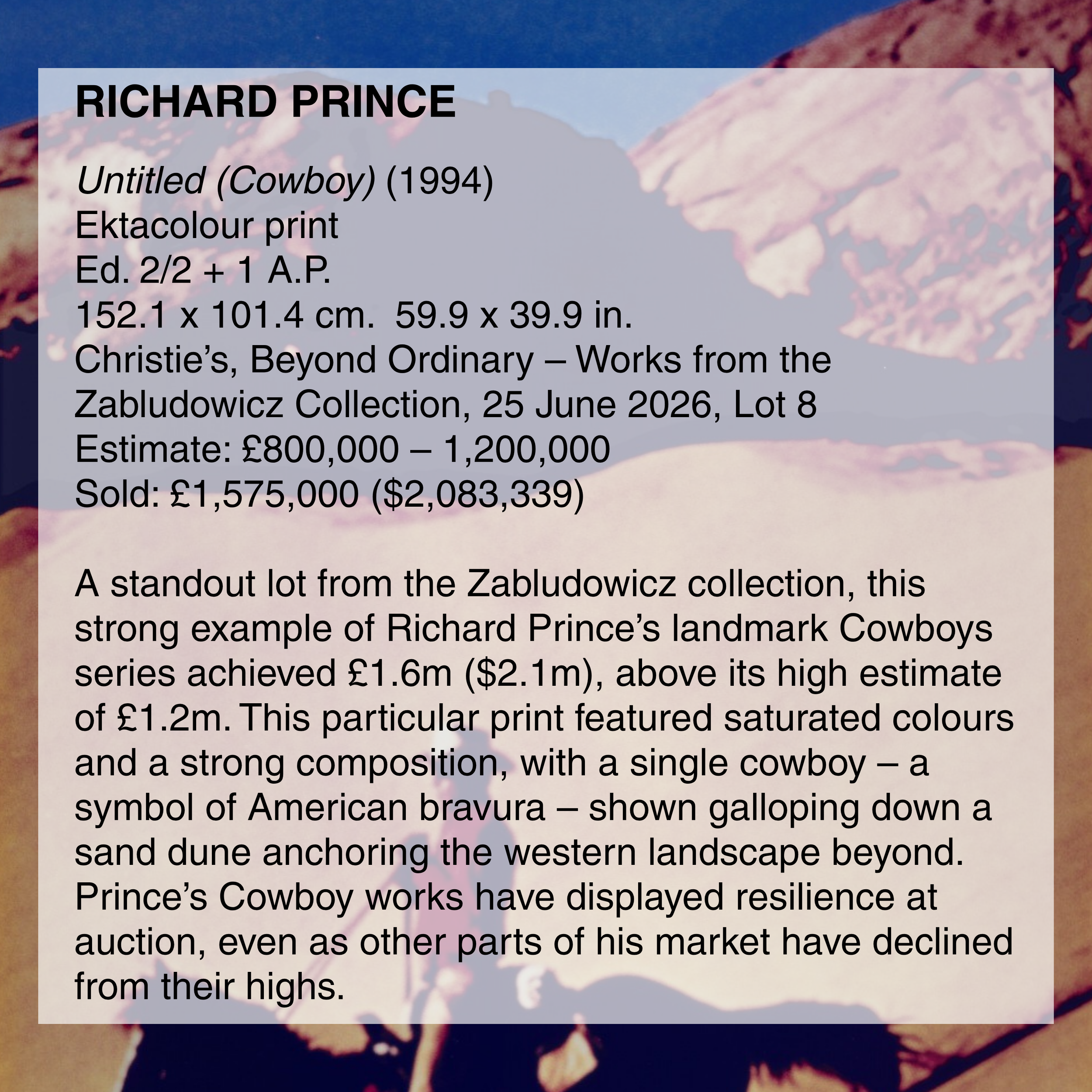
Christie’s – no longer presenting a marquee sale in June – brought a selection from the collection of Anita and Poju Zabludowicz that realized £15.4m ($20.3m). Comprising nearly entirely contemporary artists, bidding was rarely deep with appetite clearly waning in comparison to the Lewis collection. The diverging approaches taken by the two major houses to their June London sales is another factor to consider. With Christie's having scaled back its offerings to focus solely on March and October, Sotheby's benefited from greater visibility in the absence of direct competition during the week. The timing also allowed the house to capture the energy – and visitors – already in Europe for Basel, while offering consignors an additional window to move at pace or capitalize on the market's current momentum. Their dedicated focus on the Lewis Collection comes hot on the heels of the equally successful Karpidas Collection last September – again offered to great acclaim at a period of relative quiet in the auction calendar. At a time when both attention is an increasingly precious commodity and single-owner collections anchor major auctions, Sotheby’s capitalization on their rival’s retreat from the June season paid dividends.

René Magritte, La Belle promenade (1965), gouache on paper, 16.5 × 11.8 in. 41.8 × 30 cm. Sold Sotheby’s London, Masterpieces from the Lewis Collection, 25 June 2026. Sold: £16,035,000
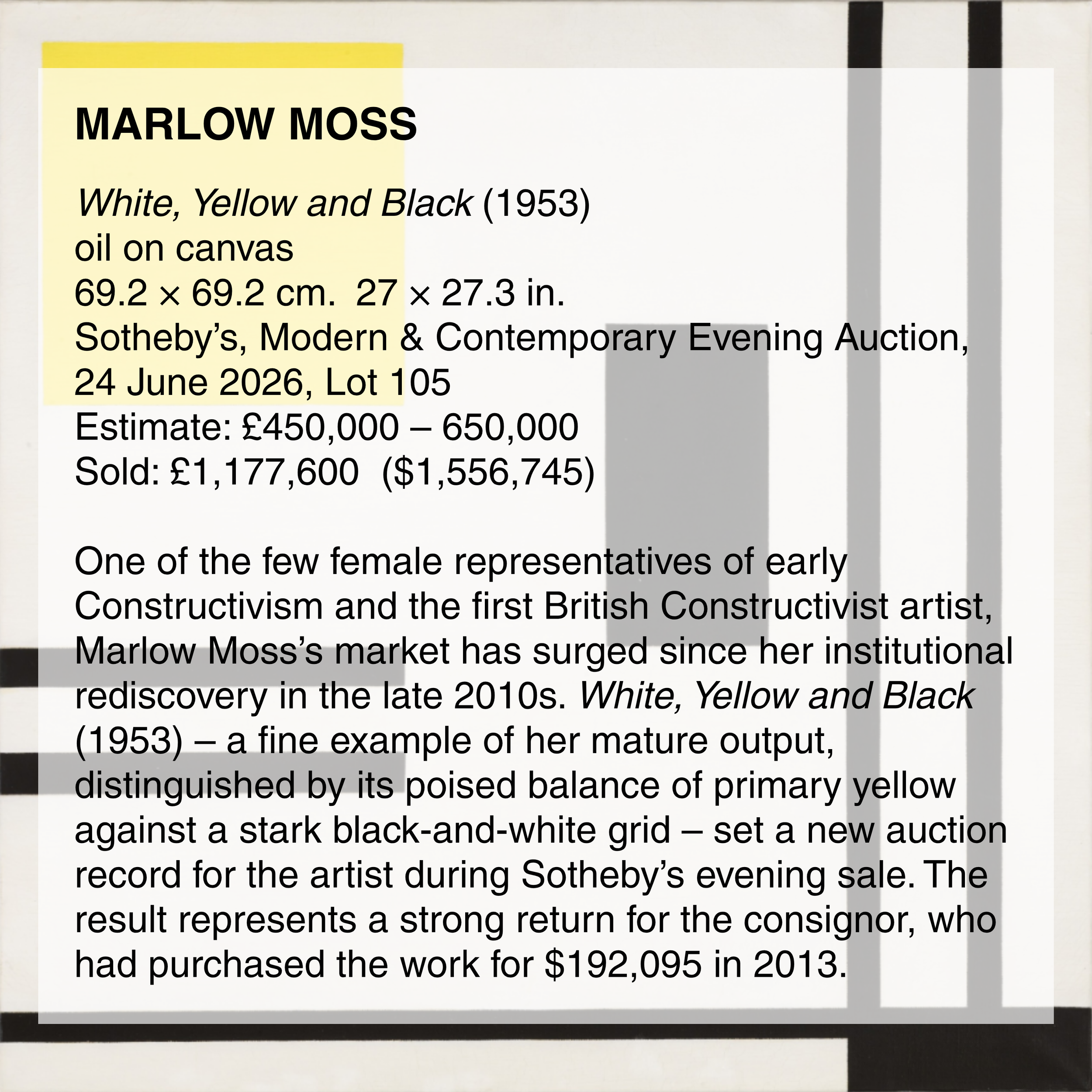
AIG Lot Picks
Upcoming at AIG

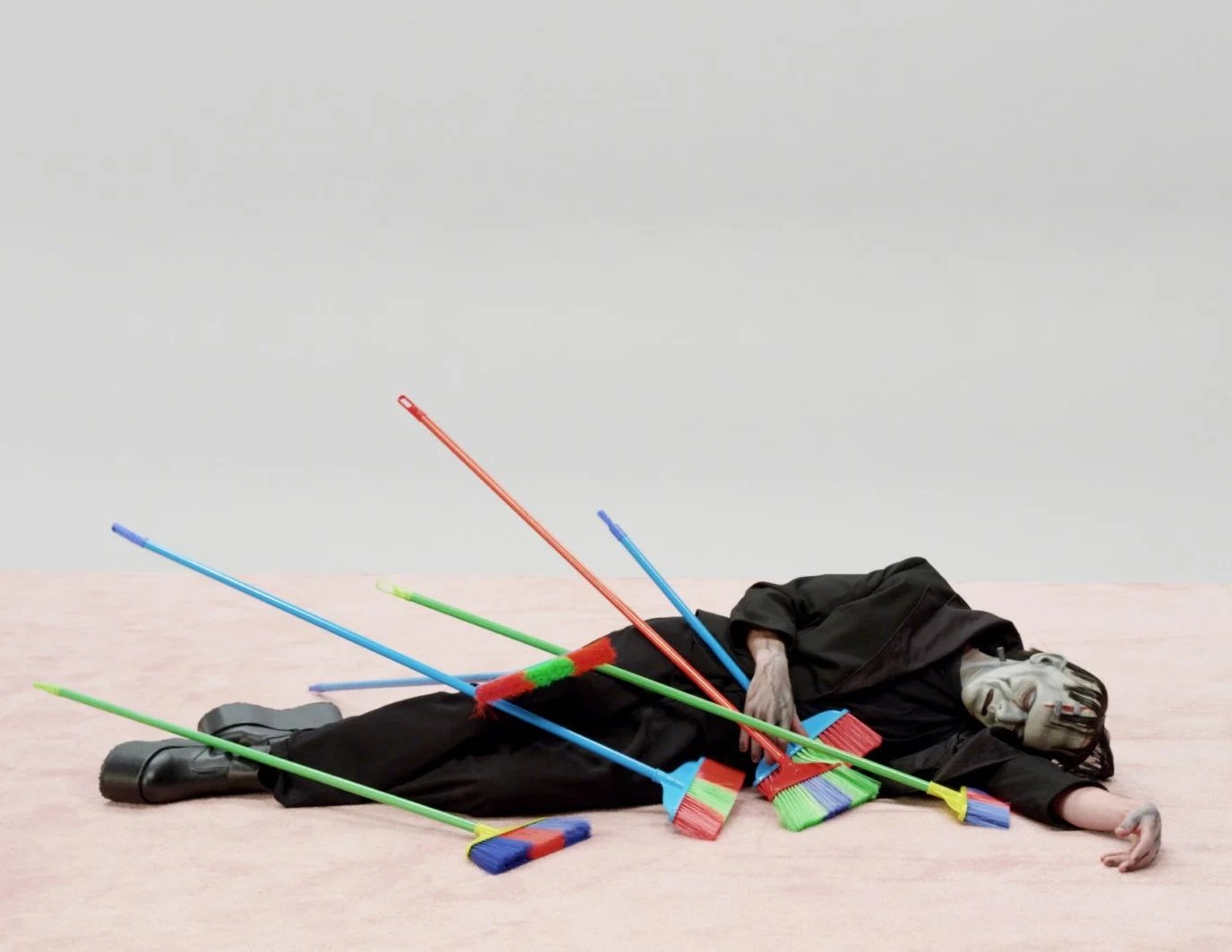
Alex Da Corte, Slow Graffiti, 2017. © Alex Da Corte. Courtesy the Artist and Sadie Coles HQ, London
16 July - 28 August 2026
Suite A, 1/F TS Tower, Heung Yip Road, Wong Chuk Hang
Art Intelligence Global is pleased to present “Glitched”, opening on 16 July 2026 at our Hong Kong gallery space. Featuring five moving image works on loan from the Akeroyd Collection, the exhibition will explore how, over multiple decades, artists have deployed glitches, looping, erasure, and distortion to create conceptual ruptures that interrogate ideas of desire, vulnerability, and identity.
Exhibition Recommendations

Copyright Art Intelligence Global, 2026.
All rights reserved.
Reach us at:
32 E 57th Street Floor 12
New York, NY 10022 USA
Suite A, 1/F, TS Tower
No. 43 Heung Yip Road, Hong Kong
info@artintelligenceglobal.com